The Forgotten Germ Trap: Why Your Workspace Lamp is Failing Salon Hygiene

The Forgotten Germ Trap: Why Your Workspace Lamp is Failing Salon Hygiene

How to remove lash glue residue from metal, salon cross-contamination.


The principle of gaseous deposition of cyanoacrylate (an ingredient in eyelash adhesive), and the contamination risks associated with knob-style mechanisms.

The Forgotten Germ Trap: Why Your Workspace Lamp is Failing Salon Hygiene
If you walk into any high-end lash bar or medical-spa, you will see a pristine environment. Tweezers sit inside UV sterilizers, disposable sheets are changed meticulously, and barbicide is everywhere.

But as an industry educator who audits salons for safety, there is one spot where almost every business owner accidentally creates a bio-hazard trap. Raise your hand if you wipe down your tweezers, your cart, and your bed, but only clean your workspace lamp once a month—or never.

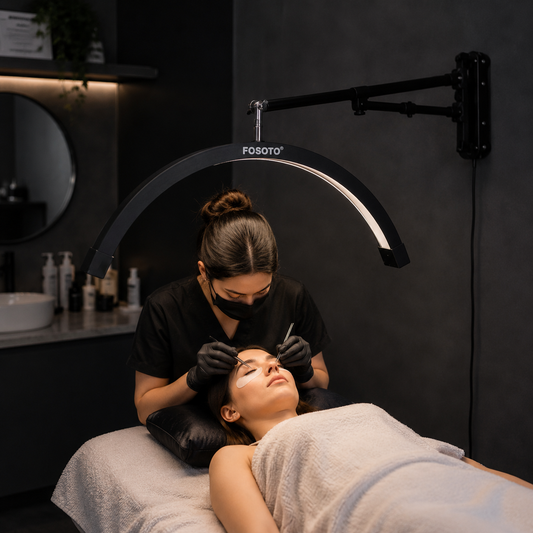
Think about it: during a lash extension or microblading session, where does your lamp sit? It hangs directly over your client's open mouth and nose, less than 12 inches away, for hours at a time.

The Physics of "Adhesive Vapor Fall"

If you are a lash artist, you work with cyanoacrylate (lash glue). As the glue cures, it undergoes a process called polymerization, releasing invisible chemical vapors into the air. Because heat rises from your client's face, these tacky, airborne vapors float upward and attach themselves to the nearest cold surface—which happens to be your working lamp.

If your lamp uses traditional mechanical turn-knobs, layered screw joints, or decorative ridges, these vapors settle into those tiny gaps. They mix with airborne skin dander, hair fragments, and dust, forming a hard, crusty, amber-colored layer.

Not only does this ruin the look of an expensive salon, but it also creates a porous surface where bacteria and cross-contamination can thrive. You can spray it with disinfectant, but it is physically impossible to get a wipe inside a threaded screw knob to clean out old glue residue.

Designing for Clinical Cleanliness

This is why the modern evolution of salon design is moving away from mechanical hardware toward seamless architecture.

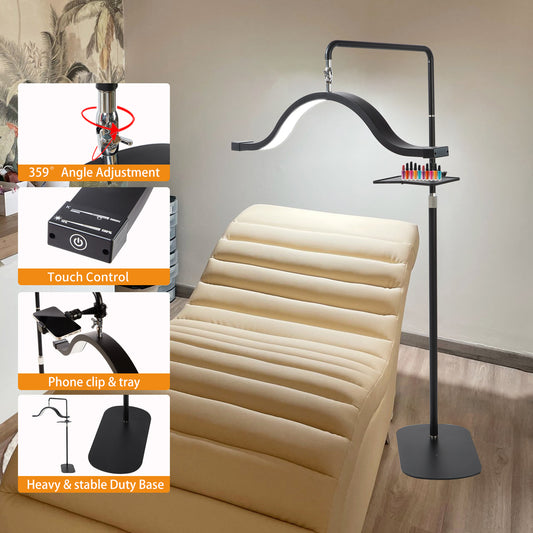
When selecting tools for a sterile medical-spa or high-volume studio, look for equipment designed with a flat, continuous chassis. Modern standards require pure-flat, tactile touch-control panels rather than protruding physical buttons.
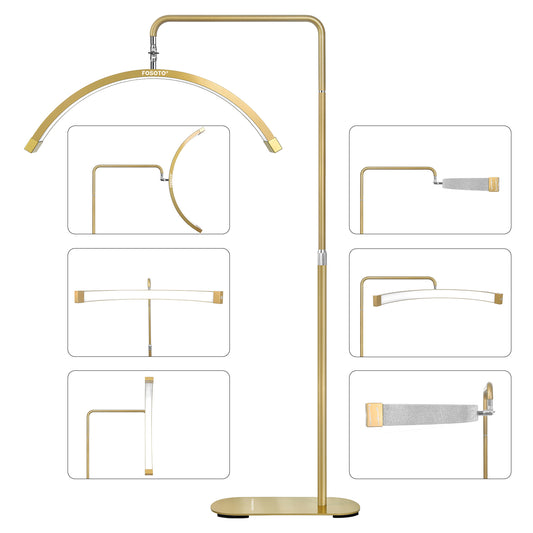
Brands like FOSOTO pioneered this shift by completely eliminating clunky knobs and sharp structural gaps from their premium half-moon collections. When your light frame is a single, continuous, smooth piece of alloy, there is nowhere for adhesive vapors or bio-dust to hide. Between clients, you take one disinfectant wipe, glide it across the smooth surface in two seconds, and your sterile field is perfectly restored.

Hygiene isn't just about the chemicals you use; it’s about choosing equipment that refuses to hold onto dirt.
Back to blog

Leave a comment

FAQ

  • A half moon light features a D-shaped design that provides even, shadow-free illumination across the entire work area. Unlike a ring light which creates a circular catchlight and leaves a shadow gap in the center, the half moon shape ensures every lash, nail, and detail is clearly visible from all angles — making it the preferred choice for lash artists, estheticians, and nail technicians worldwide.

  • Professional beauty lighting should have a CRI (Color Rendering Index) of 97 or higher, verified by an integrating sphere test report. CRI 97+ ensures skin tones, nail colors, lip shades, and lash colors appear true-to-life under the light — preventing costly color mismatches. Be cautious of budget lights that claim CRI 95+ but test at CRI 83–85 when independently measured.

  • Flicker refers to rapid fluctuations in light output that — even when invisible to the naked eye — cause eye strain, headaches, and reduced visual precision over time. FOSOTO lights are certified to the IEEE 1789-2015 standard, the international benchmark for safe LED modulation. For lash artists, makeup artists, and tattoo professionals who work under close-range lighting for hours, flicker-free certification is essential for both technician health and work quality.

  • Look for IEEE 1789-2015 (flicker-free), CE, FCC, UL, RoHS, TUV, and SELV power adapter certification. FOSOTO Half Moon Lights hold all of these certifications plus global patents in Europe, the UK, and the USA — ensuring they meet the highest safety and performance standards for professional use in salons, clinics, and studios worldwide.

  • Yes. FOSOTO's half moon lights are designed for all precision beauty and healthcare applications including eyelash extensions, nail art and gel work, tattoo artistry, PMU (permanent makeup), skincare treatments, facial procedures, and medical aesthetic clinics. The shadowless illumination, CRI 97+, and adjustable color temperature (3200K–5600K) make a single FOSOTO light suitable for every service in your studio.

  • FOSOTO lights combine three layers of eye protection: IEEE 1789-2015 certified flicker-free output eliminates invisible flicker that causes eye fatigue; CRI 97+ reduces the visual effort needed to assess fine details accurately; and the SELV-certified 15V power adapter ensures electrical safety with no risk of dangerous voltage reaching the light or user. Together, these features allow beauty professionals to work longer with less strain.

  • FOSOTO lights feature a reinforced counterbalance base weighing approximately 3.4kg, engineered to remain stable at all rotation angles including full 360° rotation. The 350° rotating lamp head prevents accidental detachment during adjustment. This structural design solves the most common failure point of budget salon lights — tipping over when rotated sideways during treatments.

Share this article with your network

Discover more professional beauty lighting solutions at FOSOTO