2026 Best Half-Moon Light: A Deep Dive into FOSOTO’s Precision Engineering & Testing Reports
The Science of Truth: Why CRI 97 is the New Gold Standard for 2026 Beauty Lighting (A Manufacturer’s Deep Dive)
Introduction: The Hidden Crisis in the Treatment Room
A lash artist spends three hours on a meticulous set, only for the client to walk out into the sunlight and realize the colors look completely different. Or a permanent makeup artist chooses a pigment that looks perfect under the lamp, but heals with a strange gray undertone.
Is it the artist’s fault? Often, no. The culprit is Spectral Distortion.
In 2026, the market is louder than ever. Everyone claims "high quality," but as the manufacturers behind FOSOTO, we believe it’s time to move past marketing slogans and talk about the physics of light. This is the story of how we spent 18 months chasing a 2% improvement—moving from CRI 95 to a verified 97—and why that tiny margin matters for your reputation.

Deciphering the CRI Lie
What is CRI, Really?
Most people know CRI (Color Rendering Index) is a scale from 0 to 100. But what they don’t tell you is that CRI is an average of the first eight test colors (R1 through R8).
A lamp can have a CRI of 90 but a terrible R9 value (the ability to render red tones). In the beauty industry, R9 is everything. Human skin, blood vessels, and micro-blading pigments all rely on the red spectrum. If your R9 is low, skin looks "dead" or ashy under the light.

The "Fake Label" Epidemic
As a factory deeply rooted in this industry, we see it every day: competitors buying cheap LED chips for $0.05 and labeling the box "CRI 95." They rely on the fact that most customers don't own a $3,000 spectrometer. We’ve made it our mission to fight this. To us, a fake label isn't just bad business; it's a betrayal of the professional who relies on that light for their precision work.

The 2026 Engineering Journey (The March Report)
The LED Selection Process
Achieving a consistent CRI of 97 across thousands of units is a nightmare for production. It requires "Binning"—a process where we sort LEDs not just by brightness, but by their exact spectral output.
In March 2026, we upgraded our sourcing. We now use a customized phosphor coating on our chips. This isn't off-the-shelf technology. By adjusting the phosphor mix, we were able to boost the R9 to 90+ and the R13 (skin tone) to nearly 98.

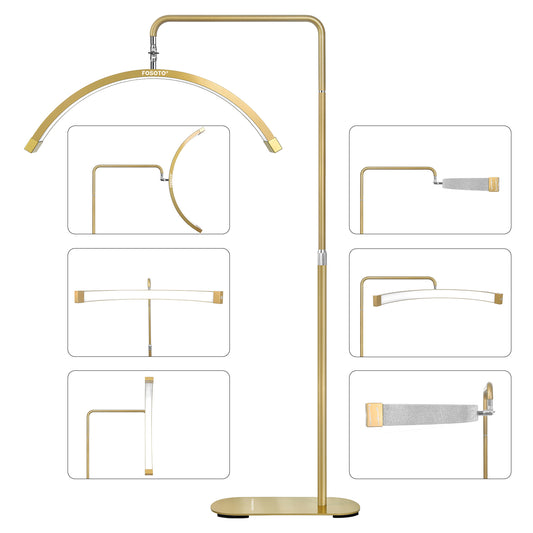
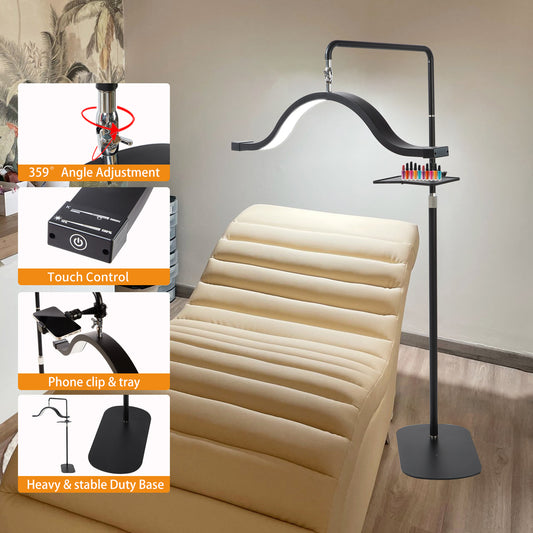
Mentioned above was recorded using our flagship Model FT-Y9 ,FT-Y16,(2026 Edition). You can see the full specs and technical teardown of this specific model [FT-Y9 half moon light/ FT-Y16 half moon light].
Thermal Stability: The Enemy of Accuracy
Here is a secret the industry won't tell you: High CRI chips get hot. And as they get hot, their color temperature shifts. A light that starts at 5600K can drift to a yellowish 5000K after two hours of work.
To solve this for our 2026 Half-Moon series, we redesigned the aluminum PCB (Printed Circuit Board). By increasing the copper thickness, we improved heat dissipation by 22%. This ensures that the CRI 97 you start with in the morning is the same CRI 97 you have at the end of a long day.

Why Professionals are Switching (Case Studies)
For Lash Artists: Depth Perception
Under low CRI light, individual lashes blend together. This leads to eye strain and slower application times. Our CRI 97 lights provide "High Contrast Clarity," allowing artists to see the separation between natural lashes and extensions with surgical precision.
For Content Creators: The End of Post-Production
If you are filming for Instagram or TikTok, low CRI lighting makes skin look "grainy" or "yellow" on camera. Sensors in iPhones and professional cameras struggle to interpret missing spectral data. With CRI 97, the camera "sees" the full spectrum. This means zero color grading in post-production. You look "Filter-Ready" in real life.

The Testing Protocol (Transparency First)
We don't ask you to trust our words. We ask you to trust our data. Every batch of our 2026 products undergoes:
-
Integrating Sphere Testing: To measure total luminous flux and efficacy.
-
Spectral Analysis: To verify the R1-R15 values.
-
Flicker-Free Validation: Using high-speed sensors to ensure zero eye fatigue (compliant with IEEE 1789).
(Screenshot of our March PPT Report here – showing the 97 data point)


Protecting Your Brand
At the end of the day, FOSOTO is a manufacturer, but we are also brand protectors. When you buy a high-precision light, you aren't just buying a tool; you are buying an insurance policy for your work.
In 2026, the best half-moon light isn't the one that's the cheapest. It’s the one that tells the truth.