Half Moon Light vs Ring Light for Lash Extensions: Which Should You Choose?
The Short Answer
For eyelash extensions and other precision beauty work, a half-moon (crescent) light is usually the stronger choice: its broad arc-shaped panel sits above the work zone, keeps shadows away from your hands and tools, and professional 28-inch models such as FOSOTO's reach CRI Ra ≥ 95 with stepless dimming and adjustable color temperature. A ring light remains a solid pick when your priority is even, diffused fill for video, tutorials, or makeup application, where its circular catchlight is a visual advantage. Below, we compare the two formats on the specifications and behaviors that actually affect your work — and the spec sheet numbers come from real FOSOTO product listings, not marketing averages.
What Is a Half-Moon Light?
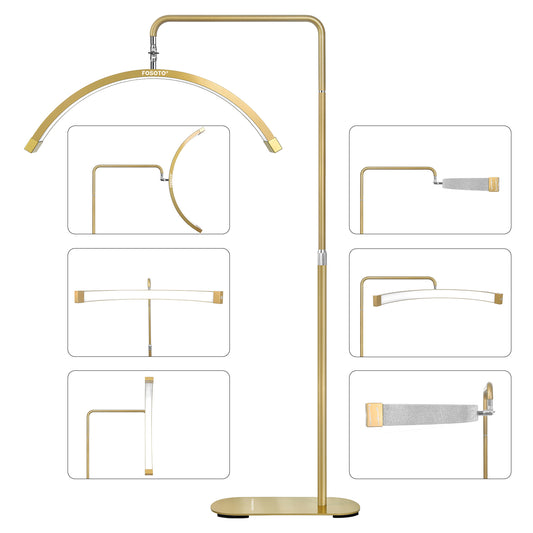
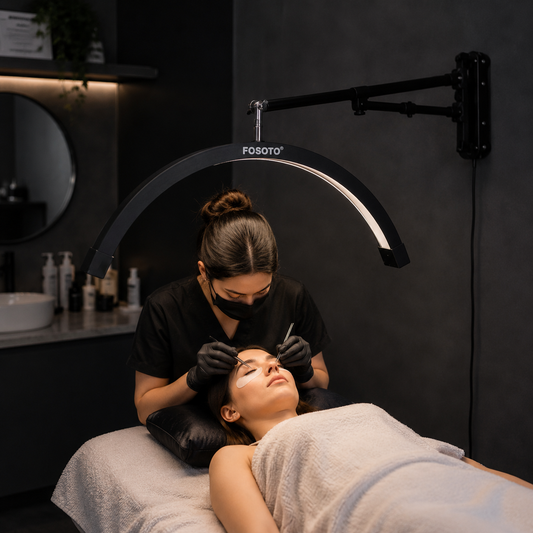
A half-moon (or crescent) light is an LED luminaire shaped like an open arc or half ring. Most professional versions are floor-standing with an adjustable stand, and the panel is angled over the client so the technician works inside the arc's open space. The format is widely sold for lash extensions, nail work, tattooing, makeup, and salon close-work because the light source sits above the hands rather than behind them.
FOSOTO's representative 28-inch model (45 W, with tool tray) and its remote-control version list these specifications:
- Power: 45 W; 320 SMD LED beads
- Color rendering: CRI Ra ≥ 95
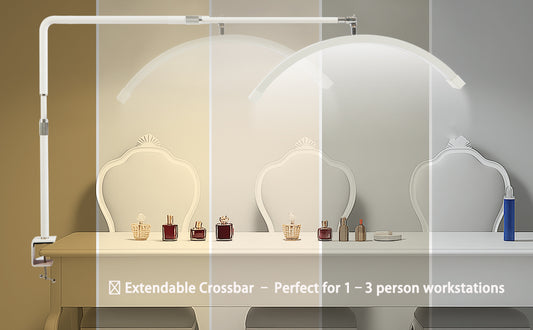
- Color temperature: adjustable 3200 K – 5600 K (bi-color), stepless dimming
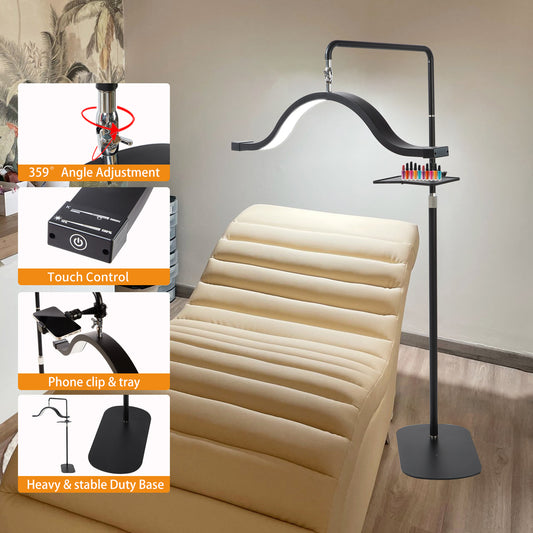
- Stand height: adjustable from 101 cm to 171 cm (39.7 in – 67.3 in); base ≈ 3.4 kg for stability; lamp head rotates 350°
- Power supply: 110 V / 240 V, 50–60 Hz, via a low-voltage adapter (15 V / 4 A)
- Extras: touch control with brightness/color-temperature memory, optional magnetic remote control, optional tool tray, OEM/ODM customization available


What Is a Ring Light?
A ring light is a circular LED panel with an open center, originally popularized for photography, video, and makeup content. Light comes from the circumference around the lens, which produces the characteristic circular highlight ("catchlight") in the subject's eyes and fairly even frontal illumination. Many beauty professionals also use ring lights on a floor stand or table mount for close work.
FOSOTO's representative 18-inch ring light (55 W) lists:
- Power: 55 W; 480 LED beads; outer diameter 18 in / 45 cm
- Color rendering: CRI Ra ≥ 90
- Color temperature: adjustable 3200 K – 5500 K, stepless dimming
- Input: wide voltage 110 V – 240 V

Half-Moon Light vs Ring Light: Side-by-Side Comparison
| Factor | FOSOTO 28" Half-Moon Light (example) | FOSOTO 18" Ring Light (example) |
|---|---|---|
| Shape & light geometry | Open arc above the work zone | Full circle around the lens, hollow center |
| Typical use | Lash extensions, nails, tattoo, precision salon work | Video, tutorials, makeup, photography, general fill |
| Power / LEDs | 45 W / 320 LEDs | 55 W / 480 LEDs |
| Color rendering | CRI Ra ≥ 95 | CRI Ra ≥ 90 |
| Color temperature | 3200 K – 5600 K, stepless | 3200 K – 5500 K, stepless |
| Mounting | Floor stand, 101–171 cm adjustable | Stand / table / camera mount options |
| Best at | Shadow control around the hands; color-critical close work | Even frontal fill; circular eye catchlight on camera |
Specifications above are the actual values in FOSOTO's product listings (accessed September 9, 2026). Other brands' models will differ — always compare the spec sheet of the exact unit you are considering.
Why the Shape Matters for Precision Work
The two formats differ most in where the light comes from, and that changes what happens around your hands:
- Shadow behavior. Because a ring light's LEDs sit on the outer circumference with an open center, the technician's head, hands, or tweezers can cast shadows into the middle of the work area as they move across the ring. FOSOTO and other half-moon manufacturers describe their open-arc design as shadow-reducing, because the light panel is positioned above the work zone instead of around it. Technician communities report the same pattern anecdotally — for example, discussions in r/lashextensions frequently mention outer-corner visibility and shadow problems with ring-style lighting.
- Catchlight and look on camera. A ring light creates a visible circular highlight in the client's eyes — desirable in beauty content. A half-moon light produces a softer, elongated highlight, which most lash and nail studios do not need for still photography.
- Glare and comfort. With a ring light, the brightest LEDs sit close to your line of sight when you lean in to work. A half-moon panel is mounted above the client, so the direct bright surface is farther from the technician's viewing angle. Choose a lamp with a diffuser and stepless dimming either way, and set the lowest comfortable brightness for close work.
Neither format is "wrong" — the trade-off is between an even circular field (ring) and a shadow-controlled work zone above your hands (half-moon).
CRI and Color Accuracy: What 90 vs 95+ Actually Means
CRI (Color Rendering Index, Ra) measures how faithfully a light source reproduces colors compared with a reference illuminant, on a 0–100 scale. It is the internationally recognized single-number metric for color rendition, and it was formally adopted in 1965 and last revised in 1974; as the U.S. Department of Energy's Solid-State Lighting program notes, CRI is a fidelity metric — newer tools such as IES TM-30 add gamut and graphic information because one number cannot fully describe color quality.
Why does that matter for lash and nail work? A large part of the job is judging fine color cues: the shade of lash adhesive, glue curing, tint application, and matching skin tone or polish color. A source with higher color fidelity reduces the guesswork in those judgments. That is the practical argument for seeking CRI Ra ≥ 90 as a baseline and Ra ≥ 95 for color-critical close work — the FOSOTO half-moon range is spec'd at Ra ≥ 95, while its ring-light range starts at Ra ≥ 90. Keep in mind CRI is only one part of color quality, and two lamps with the same Ra can render colors differently; when color precision matters, test the lamp on your own materials before committing.
Which Should You Choose?
- Primarily lash extensions, nail enhancement, tattoo, or other precision close work → choose a half-moon light. The above-work-zone geometry, Ra ≥ 95 color fidelity, and adjustable 3200–5600 K range map directly to color-critical tasks.
- Primarily beauty video, tutorials, photography, or makeup content → choose a ring light. The open-center circular format gives even frontal fill and the classic catchlight that reads well on camera.
- Mixed studio (treatments + content) → run both. A common setup is a half-moon light as the working light plus a small ring light for filming or before/after shots. Many lash techs start with a ring light and add a half-moon light as their precision workload grows.
- Space and budget. Half-moon lights are floor-standing and need roughly 1 m of floor clearance; ring lights can sit on a table or desk mount and are usually more compact to store.
What Lash Artists Actually Say
Practitioner opinions are genuinely split, which is why this guide avoids a one-size-fits-all verdict. In lash-technician communities (for example, r/lashextensions), some artists report that they switched from a ring light to a half-moon light specifically for outer-corner visibility and shadow control; others are equally happy with a good ring light and prefer its familiar, even output. The common thread is consistent: stability, adjustable brightness/color temperature, and shadow behavior matter more than brand or format.
FAQ
Can I use a ring light for lash extensions?
Yes. Many lash artists start with a ring light. Watch for two things: shadow cast by your head and hands into the ring's center, and color rendering — prefer a model rated CRI Ra ≥ 90 or higher, with stepless dimming, and place it close enough to light the work area without glaring into the client's eyes.
Is a half-moon light better than a ring light for lashes?
For most precision lash work, yes: the open-arc design keeps the panel above the work zone (fewer shadows around your hands), and professional models typically spec higher color rendering (Ra ≥ 95) than comparable ring lights (often Ra ≥ 90). The choice still depends on your space, budget, and whether you also film content.
What CRI do I need for a lash or salon light?
Use CRI Ra ≥ 90 as the working baseline and Ra ≥ 95 where color-critical judgments (lash adhesive, tint, skin tone matching) are part of the job. CRI is a fidelity metric on a 0–100 scale; higher values mean colors appear closer to their appearance under a reference illuminant.
Which is better for video and tutorials: ring light or half-moon light?
For beauty video and tutorials, a ring light is the more common choice because it delivers even frontal fill and a circular catchlight. A half-moon light can also film well when dimmed and color-tuned, but its highlight shape is different and its light is designed for overhead work zones rather than face-on camera lighting.
Does wattage tell me which light is better?
No. Wattage is an input-power figure, not a quality rating. Compare color rendering (CRI), color temperature range, dimming smoothness, and shadow behavior instead. In FOSOTO's range, the 45 W half-moon light and the 55 W ring light serve different jobs despite the similar power draw.
Sources and Accuracy Notes
Last reviewed: September 9, 2026. Product specifications are quoted from the manufacturers' own listings at the links below; color-rendering background references the U.S. Department of Energy Solid-State Lighting program (TM-30 / CRI webinar). Community statements are anecdotal and linked for reference; no medical claims are made in this article.
- FOSOTO 28" 45 W half-moon light listing (specs quoted above)
- FOSOTO 28" remote-control half-moon light listing
- FOSOTO 18" 5500 K ring light listing (specs quoted above)
- U.S. Department of Energy — Solid-State Lighting: "Understanding and Applying TM-30-15" (CRI history, fidelity metric, TM-30 supplement)
- Community discussion: r/lashextensions — lash artists on ring vs. half-moon lighting
- Related reading: What Is a Half Moon Light and Who Needs It? · How to Choose the Right Ring Light for Salon & Lash Work · Why FOSOTO Uses SELV Adapters: A Safer Power Solution for Professional Lighting