CRI — Why It Matters More Than Brightness
What is CRI?
CRI stands for Color Rendering Index. It is a measurement from 0 to 100 that describes how accurately a light source renders the true colors of objects compared to natural sunlight, which has a perfect CRI of 100.
A light with a CRI of 70 will make colors appear dull, shifted, or inaccurate. A light with a CRI of 95 will render colors almost identically to how they appear in natural daylight. For beauty professionals, this difference is not cosmetic — it directly affects the quality and accuracy of every service you perform.
CRI is more important than brightness for professional beauty work. A very bright light with low CRI will still produce inaccurate color rendering. A moderately bright light with CRI 95+ will allow you to see and match colors accurately every time.

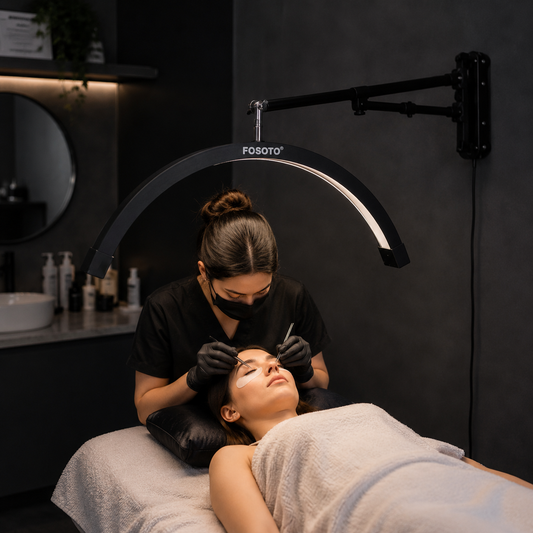
High CRI lighting ensures the pigment color you see during a PMU procedure is the color the client sees in natural daylight.
What the CRI scale means in practice
CRI below 80 — Colors appear noticeably dull and shifted. Warm tones look muddy, cool tones look grey. Not suitable for any professional beauty application.
CRI 80–89 — Acceptable for general retail and office environments. Colors are reasonably accurate but with visible shifts in saturated hues. Not recommended for PMU, lash, or nail color work.
CRI 90–94 — Good color accuracy. Suitable for most professional beauty applications including lash extensions, facial treatments, and general nail work. The minimum standard for a professional salon environment.
CRI 95–99 — Excellent color accuracy. Recommended for PMU, color-critical nail work, and any application where pigment or color matching is performed. Colors appear virtually identical to natural daylight.
CRI 100 — Perfect color rendering, equivalent to natural sunlight. Achieved only by natural light itself.
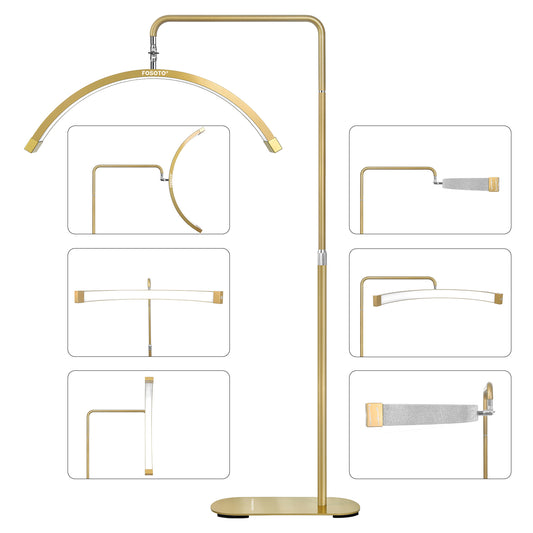
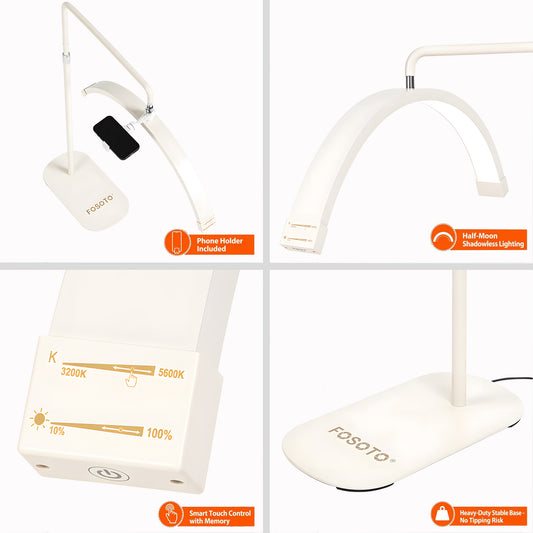
FOSOTO professional half moon lights are rated at CRI ≥ 90 across the range, with select models reaching CRI 95+.
Why low CRI causes real problems in beauty work
PMU color matching
This is where low CRI causes the most serious professional consequences. When a PMU artist selects a pigment color under a low-CRI light, the color they see is not the true color of the pigment. Warm brown pigments appear more orange. Cool ash pigments appear more grey. The artist compensates by selecting a different shade — and when the client steps into natural daylight, the result looks nothing like what was intended.
A significant proportion of PMU color corrections are caused by inaccurate lighting, not technique. Switching to a CRI 95+ light eliminates this variable entirely.
Lash adhesive assessment
During lash extension application, the technician needs to assess adhesive placement, bonding quality, and the condition of the natural lash. Under low-CRI light, the subtle color differences between a well-bonded extension and one with excess adhesive are harder to distinguish. High-CRI lighting makes these details visible and reduces the risk of adhesive-related issues.
Nail color selection and gel assessment
Gel nail colors look different under different light sources. A gel that appears a perfect dusty rose under warm low-CRI light may look noticeably pink or purple in natural daylight. For nail technicians who offer color consultations and custom color mixing, CRI 90+ is essential for accurate color presentation to clients.

High CRI lighting at the nail desk ensures gel colors appear as they will in natural light.
CRI and color temperature work together
CRI and color temperature are separate specifications that both affect how colors appear under a light source. You need both to be correct.
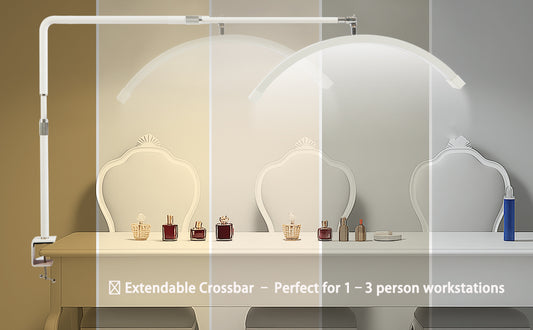
A light can have a high CRI of 95 but be set to 3200K warm white — colors will be rendered accurately, but with a warm shift that still makes cool pigments appear warmer than they are in daylight. For PMU work, you need CRI 95+ at 5500–5600K to achieve both accurate color rendering and daylight-equivalent color temperature.
Conversely, a light set to 5600K with a CRI of 75 will have the correct color temperature but poor color accuracy — colors will still appear shifted and dull despite the daylight-equivalent Kelvin setting.
See our Color Temperature guide for a full explanation of how to choose the right Kelvin setting for your service type.
How to check the CRI of a light before buying
CRI should be listed in the product specifications. Look for it labeled as "CRI", "Ra", or "Color Rendering Index". Be cautious of listings that do not include a CRI specification — this often indicates a low-CRI product where the manufacturer prefers not to disclose the rating.
What to look for:
- For general salon use: CRI ≥ 90
- For lash and facial work: CRI ≥ 90
- For PMU and color-critical nail work: CRI ≥ 95
- For photography and content creation: CRI ≥ 95
All FOSOTO professional half moon lights include CRI specifications in their product listings. Models rated CRI 95+ are identified in the product title or specifications section.

FOSOTO half moon lights are rated CRI ≥ 90, with select models at CRI 95+ for color-critical applications.
FOSOTO models with CRI 95+
→ FOSOTO Foldable 2-in-1 Half Moon Light with Mirror — CRI 95+