The Forgotten Germ Trap: Why Your Workspace Lamp is Failing Salon Hygiene
How to remove lash glue residue from metal, salon cross-contamination.
The principle of gaseous deposition of cyanoacrylate (an ingredient in eyelash adhesive), and the contamination risks associated with knob-style mechanisms.
The Forgotten Germ Trap: Why Your Workspace Lamp is Failing Salon Hygiene
If you walk into any high-end lash bar or medical-spa, you will see a pristine environment. Tweezers sit inside UV sterilizers, disposable sheets are changed meticulously, and barbicide is everywhere.

But as an industry educator who audits salons for safety, there is one spot where almost every business owner accidentally creates a bio-hazard trap. Raise your hand if you wipe down your tweezers, your cart, and your bed, but only clean your workspace lamp once a month—or never.
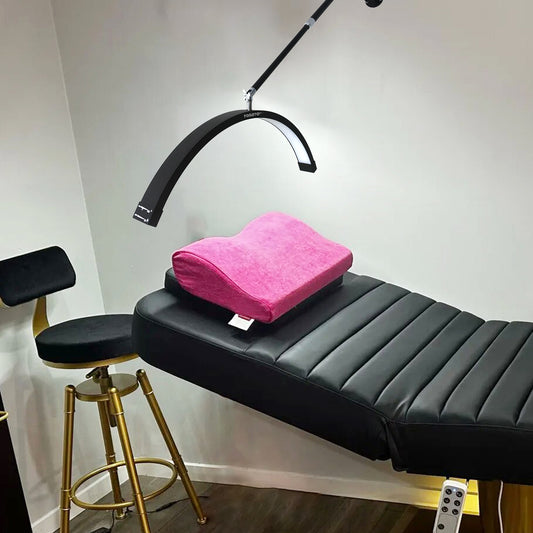
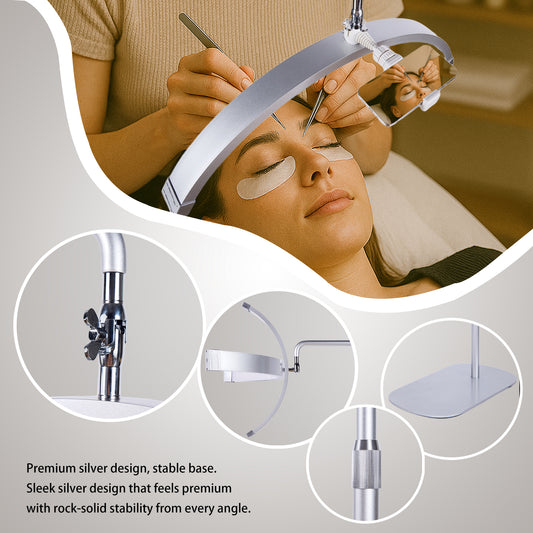
Think about it: during a lash extension or microblading session, where does your lamp sit? It hangs directly over your client's open mouth and nose, less than 12 inches away, for hours at a time.
The Physics of "Adhesive Vapor Fall"
If you are a lash artist, you work with cyanoacrylate (lash glue). As the glue cures, it undergoes a process called polymerization, releasing invisible chemical vapors into the air. Because heat rises from your client's face, these tacky, airborne vapors float upward and attach themselves to the nearest cold surface—which happens to be your working lamp.
If your lamp uses traditional mechanical turn-knobs, layered screw joints, or decorative ridges, these vapors settle into those tiny gaps. They mix with airborne skin dander, hair fragments, and dust, forming a hard, crusty, amber-colored layer.
Not only does this ruin the look of an expensive salon, but it also creates a porous surface where bacteria and cross-contamination can thrive. You can spray it with disinfectant, but it is physically impossible to get a wipe inside a threaded screw knob to clean out old glue residue.
Designing for Clinical Cleanliness
This is why the modern evolution of salon design is moving away from mechanical hardware toward seamless architecture.
When selecting tools for a sterile medical-spa or high-volume studio, look for equipment designed with a flat, continuous chassis. Modern standards require pure-flat, tactile touch-control panels rather than protruding physical buttons.

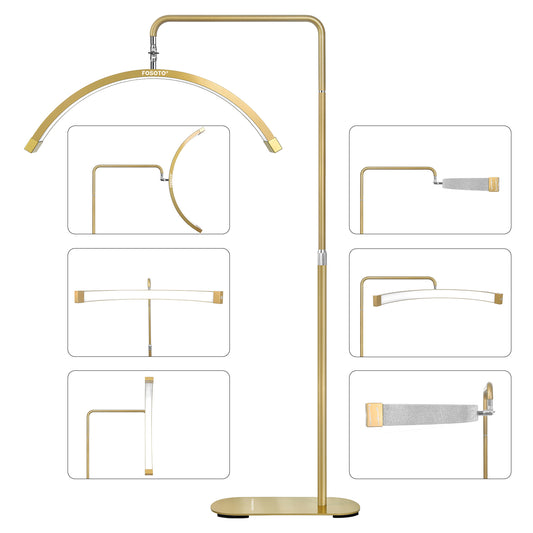
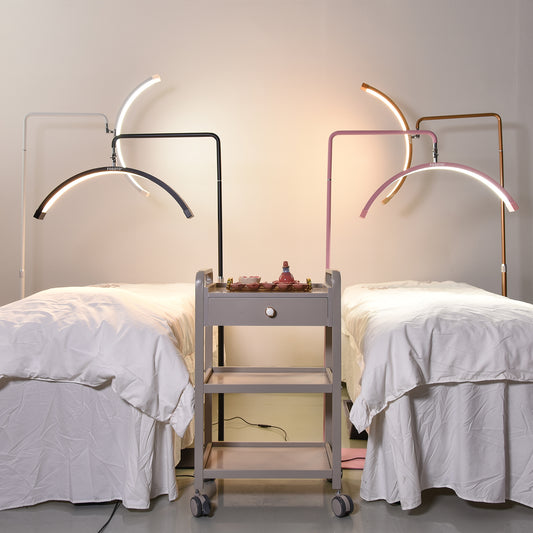
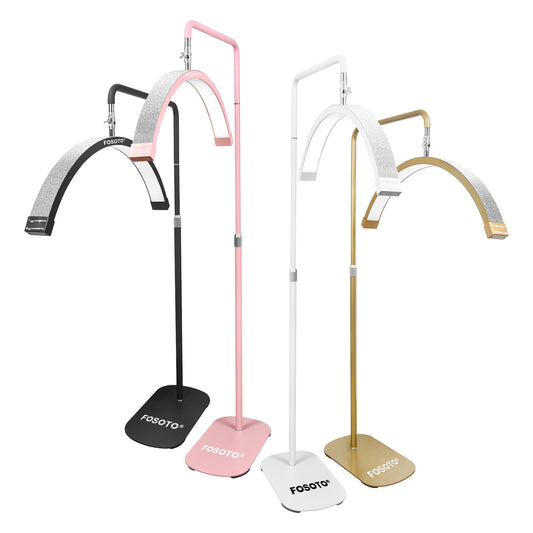
Brands like FOSOTO pioneered this shift by completely eliminating clunky knobs and sharp structural gaps from their premium half-moon collections. When your light frame is a single, continuous, smooth piece of alloy, there is nowhere for adhesive vapors or bio-dust to hide. Between clients, you take one disinfectant wipe, glide it across the smooth surface in two seconds, and your sterile field is perfectly restored.
Hygiene isn't just about the chemicals you use; it’s about choosing equipment that refuses to hold onto dirt.