Black Friday 2026 Is November 27: Run This 10-Minute Lighting Audit First
Every November, the same message lands in my inbox
“Bookings are full for the last week of November. I have six promos to shoot. And last year’s photos still look… off.”
Nine times out of ten the lights are not broken. They are inconsistent — one lamp bought two years ago at 3200K, a newer one at 5600K, both sitting in the same treatment room.
Black Friday 2026 falls on Friday, November 27, and Cyber Monday follows on Monday, November 30. That leaves roughly two and a half weeks to fix the room before the busiest booking window of the year. The audit below takes about ten minutes and needs nothing but your phone and a sheet of white paper.
Why the holiday rush exposes lighting problems
Three things change in late November, and all three make weak lighting more visible:
- Volume. Back-to-back appointments leave less time to fix a shot in editing — or to redo a colour match.
- Content. Holiday promos, gift cards and last-minute-slot posts all need photos and clips shot in the same room, often at night.
- Colour-critical work. PMU, lash tinting and nail colour all get judged by clients in daylight, on the walk home.
None of those problems is solved by a brighter lamp. They are solved by a predictable one.
The 10-minute audit
Check 1 — Is every lamp the same colour temperature?
Hold a sheet of white paper at each workstation and turn on every lamp in the room. Compare the paper side by side.
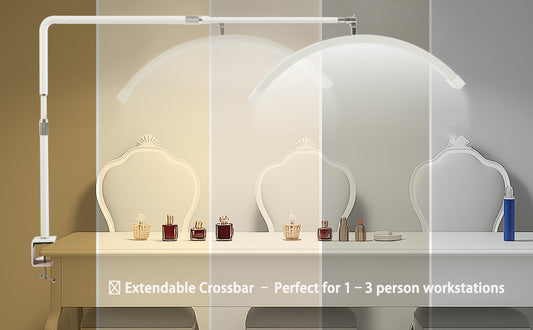
If one corner reads warm and yellow while another reads cool and blue, your room is running mixed colour temperatures. Colour temperature (CCT) is measured in kelvin — see the standard reference on colour temperature — and the two values that matter in beauty work are roughly 3200K (warm, flattering, good for evening ambience) and 5600K (daylight-neutral, good for colour matching).
A client who sits under the 3200K lamp on Monday and the 5600K lamp on Thursday will see two different skin tones. So will her camera.
Pass: every lamp in the treatment area runs the same preset, and you can switch the whole room together.
Fail symptom: foundation that matched in the chair looks grey in the corridor mirror.
Check 2 — What is the actual CRI?
Put a red lipstick and a navy fabric under the lamp. Now hold the same two items next to a window in daylight.
If the red turns brown, or the navy collapses toward black, the lamp is lying to you. The number printed on the box as “CRI” is properly the CIE Ra value — the colour rendering index measures how faithfully a source reveals colour compared with daylight. It is not a measure of brightness, and it is not a measure of how white the light looks.
For colour-critical work, treat Ra 90 as a floor, not a target. Ra 95+ is what you want for PMU, lash tinting and nail colour, where a half-shade error becomes a complaint. We went deeper on this in our CRI explainer.
Pass: the swatches look the same under the lamp as they do by the window.
Fail symptom: a colour that photographs beautifully and looks wrong in daylight.
Check 3 — Does it flicker on camera?
Open your phone camera, point it at the lamp surface, and record for ten seconds. Then dim the lamp to about half and record again.
Rolling dark bands across the frame mean the driver is modulating the LED faster than your eye notices but slower than the shutter. You will not see it in the room. Your clients will see it in every video you post.
Pass: no visible banding at any dim level.
Fail symptom: stripes in Reels, or a headache after a three-hour session.
Check 4 — Where do the shadows land?
Put your hands in your normal working position, about 10 cm above the surface. Look at the shadow edge.
A hard edge with a bright core means a point source: every ridge and pore is being emphasised. A soft gradient means the light is diffused. For lash and PMU work the real enemy is not the shadow on the client — it is the shadow cast by your own hands.
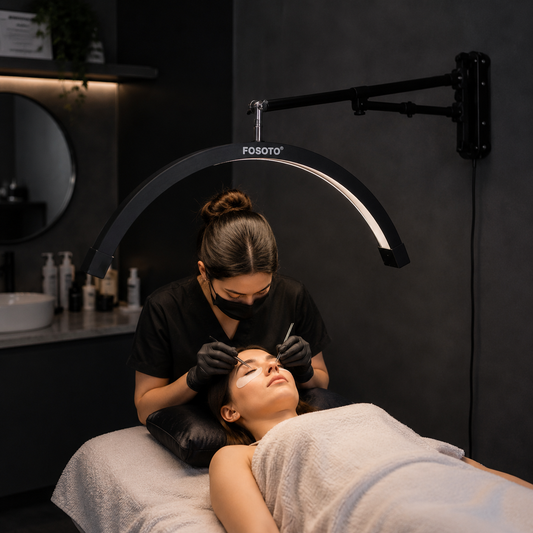
This is the one place where lamp geometry matters more than specs. A ring light gives even frontal light and a circular catchlight, but flattens depth. A half-moon panel throws light down from above and leaves the working area shadow-free — we compared the two in Half Moon Light vs Ring Light for Lash Extensions. If you are new to the format, this primer covers who actually needs one.
Pass: no hard shadow crosses the working area when your hands are in position.
Fail symptom: you keep tilting your head to see around your own shadow.
Scorecard
| Check | Pass criteria | What it costs you if it fails |
|---|---|---|
| Colour temperature | All lamps on one preset, switchable together | Colour matching that only works in one chair |
| CRI (CIE Ra) | Ra ≥ 95 for colour-critical work | Redos, colour complaints, a weak portfolio |
| Flicker | No banding on camera at any dim level | Unusable video, eye strain in long sessions |
| Shadow control | No hard shadow across the working area | Slower sets, missed detail, fatigue |
Fix in this order
- Unify colour temperature first. It is the cheapest change and the one clients notice immediately.
- Then CRI. If two lamps disagree on red, the lower one is costing you reworks.
- Then geometry. Move the light, or change the shape of it, before you buy more of it.
- Then flicker. If a lamp bands on camera, it is a video problem, not an ambience problem — retire it from the filming corner.
What not to buy on Black Friday
Discount season rewards the wrong specs. Three traps:
- More lumens. Brightness is the easiest number to print and the least useful one in a treatment room.
- A CRI claim with no test data. Ask for the integrating-sphere report, not the marketing line.
- An uncertified bargain. For professional use, confirm CE, RoHS and UKCA at minimum, plus a photobiological safety assessment for anything that runs close to the face.
What is actually worth paying for: an adjustable CCT range, Ra 95+, flicker-free dimming, and a mounting system that holds its angle.
Before you shoot the holiday promo
Run the four checks, fix the first thing that fails, and shoot one test clip on your phone before the client arrives. Ten minutes now saves the retouch you would otherwise do at midnight on November 26.
Two lamps that already pass the audit
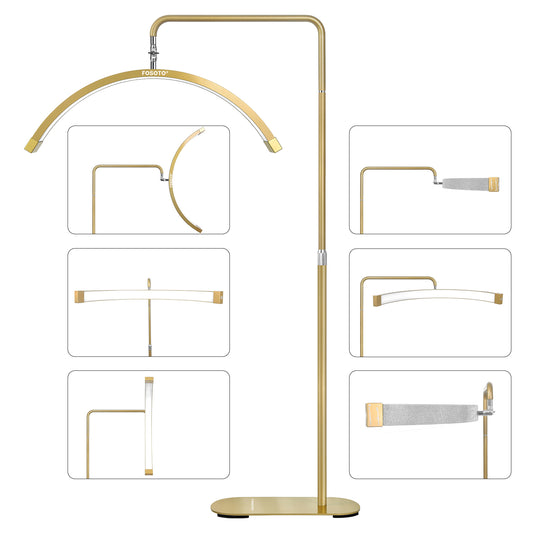
 FT-Y9 Half-Moon Lash Light |
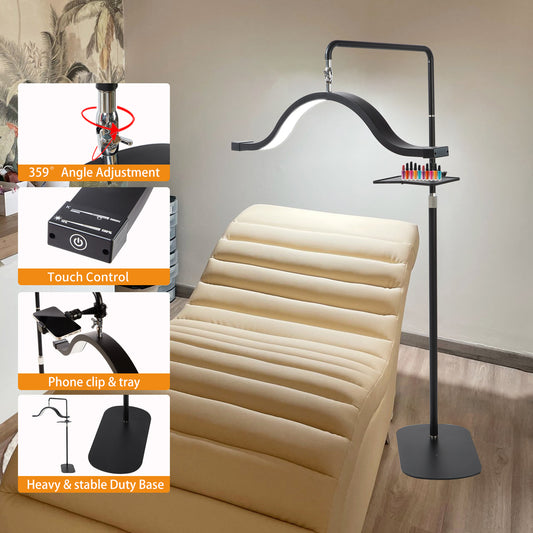
 FT-Y16 Multifunctional Half-Moon |
Not sure which geometry fits your room? Send us the dimensions and a photo of your current setup — we will tell you which check is failing before you spend anything.