What is R9 and why is it so important for lighting in beauty salon?
A studio asked us for two measurements before buying a task light. What they asked for turned out to be a better specification than most of the industry publishes — so here is the data, and how to check it yourself.
The email that started this post
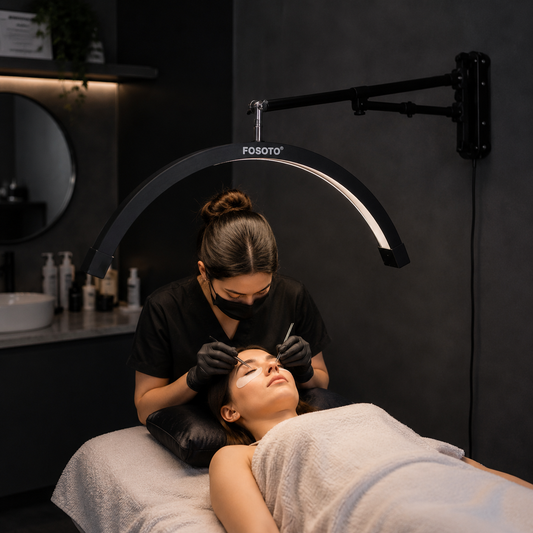
A studio wrote to us last month. I'll paraphrase it, because the details of somebody's treatment room aren't mine to publish.They are a paramedical and cosmetic tattoo studio. They were choosing a task light and had narrowed it to our 29-inch FT-Y22, the ceiling-mounted half-moon. They had a specific working geometry: the lamp about three feet above the client, so there is room for hands, needles and a stool between the light and the face.
And they asked for exactly two numbers.
The measured R9 at 5000K, or the closest setting we had actually tested. They wanted at least 80.


And the illuminance at full brightness, at the centre of the work area, 36 inches (91 cm) directly below the lamp. If we had only tested at one metre, they would take that reading and the test distance with it.
Two numbers and a document. Not a brochure. Not a colour chart. Not "high CRI, salon grade, professional quality".
That is what a professional sounds like when the light is a tool rather than a decoration. And it is the reason this post exists: the answer is more interesting than the question, and most of the industry cannot answer it.
Why a “Color Rendering Index of 95” tells you almost nothing about the color red
Start with what Ra actually is, because the whole problem hides inside the definition.
Ra — the number on nearly every light box sold to salons — is the average of eight colour samples, R1 through R8. Those eight are pastel, medium-saturation, low-chroma patches. Dusty pink, olive, mustard, light blue. They are the colours of a paint catalogue, not the colours of a lip.
R9, saturated red, is excluded from that average. So is R12, strong blue. So is R13, the skin tone sample. The measurement standard does not hide this; the marketing does.
That exclusion creates an obvious loophole. A phosphor blend can be tuned to score 95 on the eight pastel samples while its red reproduction collapses to 40, or 20, or in some cheap panels, effectively zero. The box still says CRI 95. The number is not a lie in the arithmetic sense. It is simply an average of the things that were easy.
Here is the same idea from the other direction, and it is the sentence I would underline:
A lamp can render a whole paint shop correctly and still make a fresh lip blush look muddy, because red was never in the average.
For a lash artist, an R9 in the forties mostly costs you a slightly dull photograph. For a cosmetic tattoo artist, R9 is the difference between judging a healed lip colour and guessing at it.
What a low-R9 lamp actually does to a lip
Under a light with weak red output, three things happen at once, and they compound.
Fresh pigment looks cooler than it is. Lip pigments sit in the red-orange band, and correction work sits in the opposite direction — greens, blues, violets over old work. When the red channel is underfed, a warm coral reads ashier, a brick reads browner, and an orange-based correction reads closer to neutral than it will heal. You compensate. You add warmth. The client leaves with something more saturated than the swatch.
Healed and fresh stop being comparable. Fresh pigment is sitting in traumatised, slightly swollen skin. Healed pigment has settled under a different optical layer. Judging that transition requires the lamp to be neutral on red, because red is the variable you are watching move.
Photographs lie in a specific, repeatable way. Before-and-after images taken under a low-R9 panel will shift the same direction every time. It is not a camera problem, and no white-balance slider fixes a spectral hole.
None of this is dramatic. It is a few degrees of drift, per client, per session. Which is exactly why nobody notices until they work under a lamp that does not do it.
The second number: lux where the hands are
The other half of that email is the part almost no supplier answers, and it is the more practical half.
A ceiling lamp's job is not to be bright at the ceiling. It is to be bright at the face, three feet down, while a person's forearms are between the light and the skin.
Illuminance falls with distance. For a small source, roughly with the square of it — halve the distance, quadruple the lux. So a fixture rated at some impressive number at 50 cm is delivering a small fraction of that at 91 cm:
- 50 cm → 100% (reference)
- 70 cm → about 51% of the 50 cm value
- 91 cm (36 in) → about 30% of the 50 cm value
- 100 cm → about 25%
That is the honest arithmetic, and it is why "2500 lux" printed without a distance is a marketing number, not a specification. A lux value is meaningless unless it comes with a distance, a colour temperature, and the brightness setting it was taken at.
The half-moon is not a point source, of course. A 73 cm panel spreads its output across its whole face, so its real falloff at three feet is gentler than the pure inverse-square prediction. That is one genuine advantage of the arch format: the light arrives from a wide area around the face rather than from a single hot spot, so shadows under the nose and along the jaw soften instead of going black.
But "gentler than inverse square" is still a curve, not a promise. You need the measurement.
What our bench actually measured
We do not outsource this. The two photographs below are our own photometric bench: an integrating sphere, a spectroradiometer, and the photometric-colour-electric integrated test system that drives it.
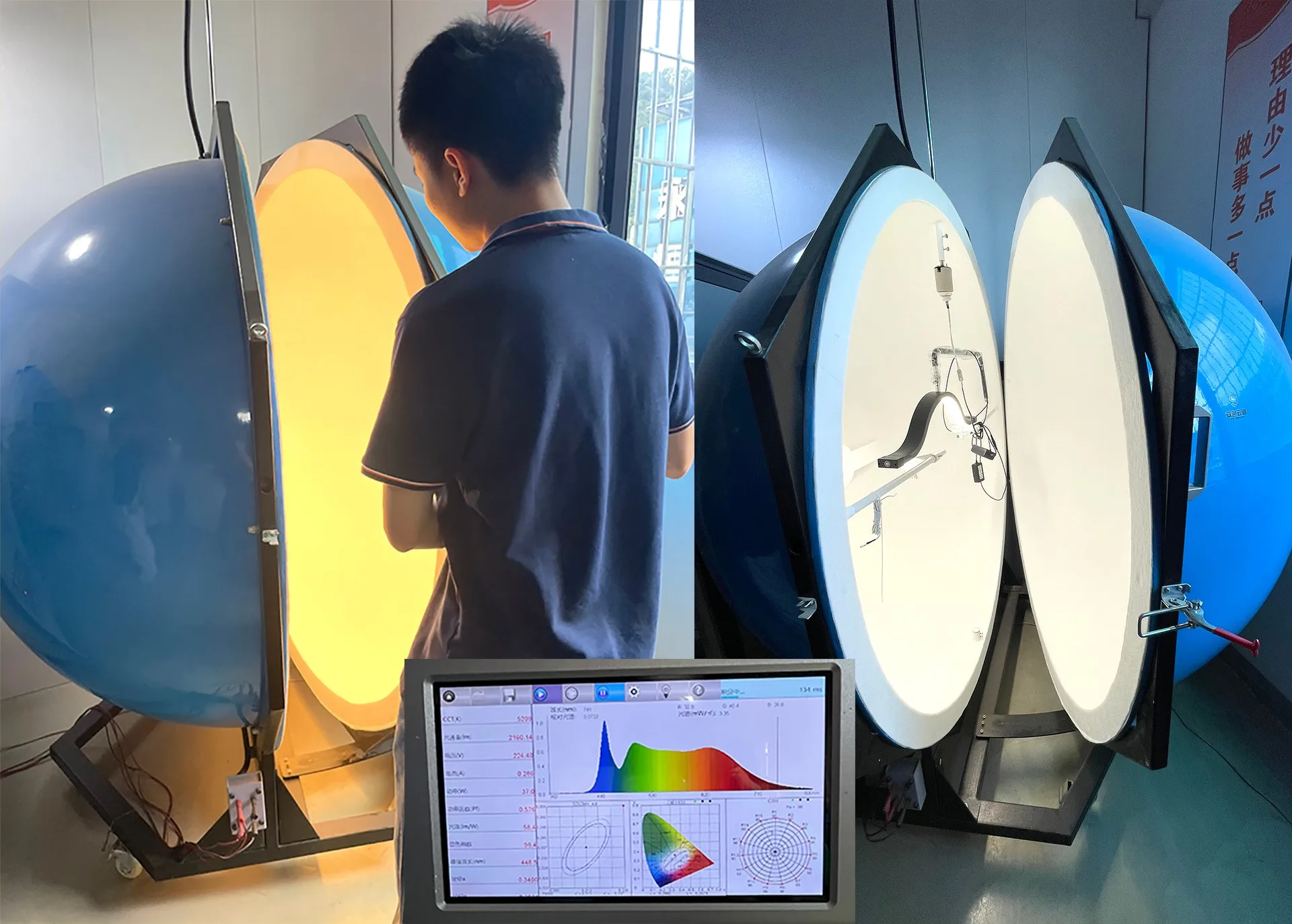
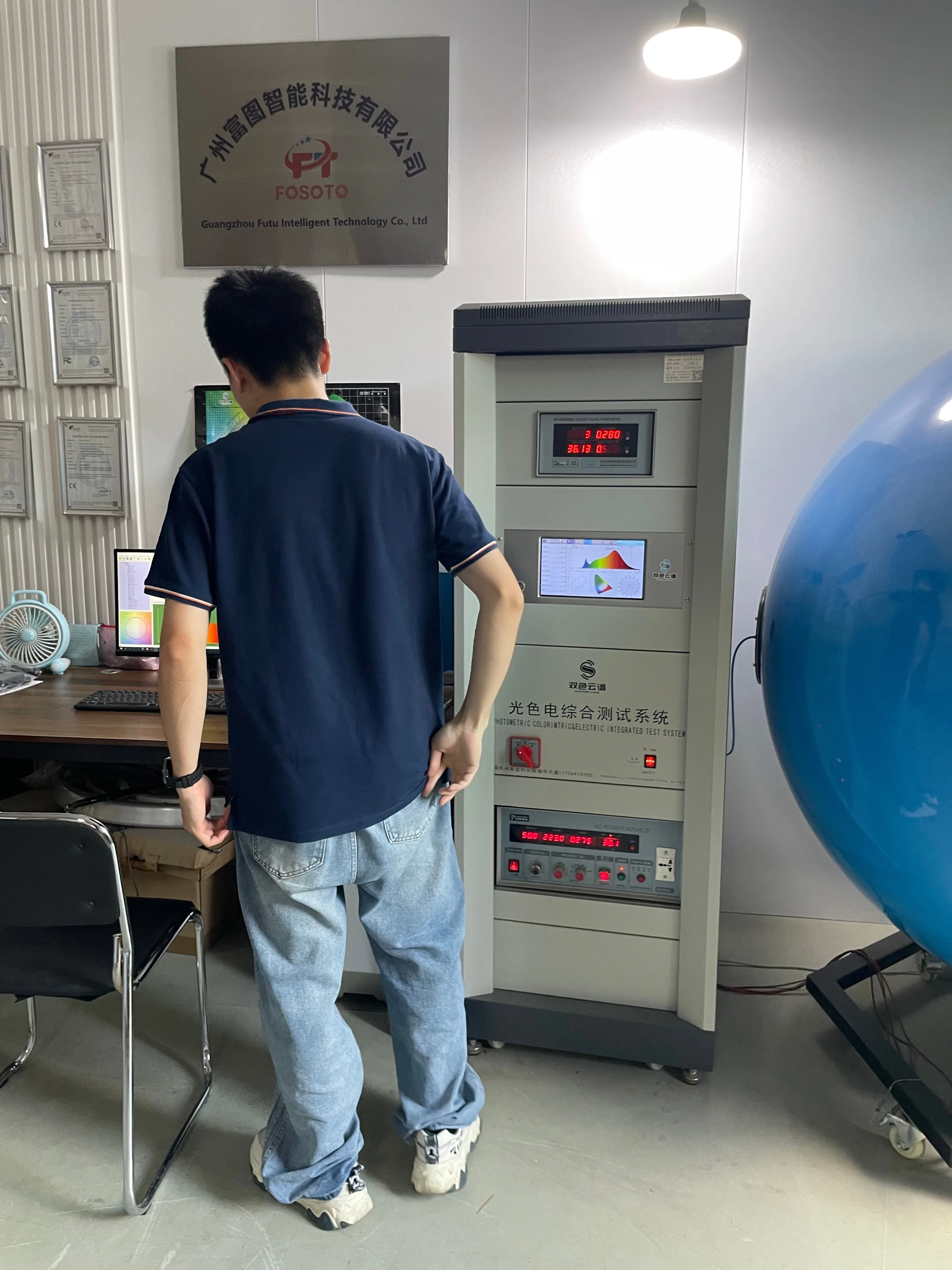
The report below is a spectral test of our professional LED light engine, run on 30 March 2026, at two colour temperatures — one near 6000K, one near 2900K. Every number in the table is read directly from that report. Nothing is rounded up and nothing is averaged across models.
| Parameter | Near 6000K | Near 2900K | What it tells you |
|---|---|---|---|
| CCT (measured) | 5,958 K | 2,875 K | Actual colour temperature, not the dial setting |
| Ra (R1–R8 average) | 96.3 | 97.5 | The number on the box |
| R9 (saturated red) | 97.6 | 86.6 | Reds, lips, correction pigments |
| R12 (strong blue) | 75.5 | 86.5 | The weakest figure in this report |
| R13 (skin tone) | 97.1 | 98.7 | Complexion fidelity |
| R15 (medium skin) | 95.0 | 97.8 | Second skin reference |
| TM-30 Rf / Rg | 90.5 / 98.5 | 93.3 / 99.8 | Modern fidelity + gamut |
| CQS | 94.1 | 90.8 | Alternative quality scale |
| CQS pigment group | 86.2 | 96.0 | Pigment-specific sample set |
| SDCM | 1.6 | 2.5 | Unit-to-unit colour consistency |
| Input power / flux | 39.3 W / 2,405 lm | 40.0 W / 2,262 lm | What it draws vs what it emits |
Three things in that table matter more than the rest.
R9 survives at both ends of the range. 97.6 in the daylight-ish setting, 86.6 in the warm setting. Both are far above the 80 floor the studio asked for. This is not an accident of one good sample: it is what happens when the red phosphor is specified rather than left to chance.
We are publishing the number we like least. R12, strong blue, reads 75.5 at 5,958 K. That is a real limitation, and a supplier who shows you only Ra would never have put it in front of you. You can decide whether blue matters for your work — for most pigment and skin work it matters far less than red — but you should be able to decide.
SDCM 1.6 and 2.5 mean two lamps in one room look the same. If you run two half-moons over two chairs, or replace one unit three years later, colour consistency between fixtures is what stops "the left chair looks warmer". Most beauty lighting is sold without any binning guarantee at all.
The floor of 80, and the five questions that get you there
The studio set R9 ≥ 80 as a threshold. I think that is the right number, and I would go further: for cosmetic and paramedical tattoo work, R9 80 is a floor, not a target. Below 80 you are compensating. Above 90 you stop thinking about the lamp.
If you are buying light for pigment work — tattoo, PMU, nail, or colour-matched esthetics — ask these five things, in this order, and do not accept a brochure as an answer:
- "What is the measured R9, at which CCT?" Not "high CRI". Not "95+". A number, and the colour temperature it was measured at, because R9 moves with CCT.
- "What is the illuminance at my working distance, at full brightness?" Give them your distance in centimetres or inches. If they answer in lumens, they have answered a different question — lumens describe total output, lux describes what lands on the skin.
- "What is the R12 and R13?" R12 tells you how honest the blue end is (relevant for cool-toned pigments and for photographing violet). R13 tells you whether skin itself reads correctly.
- "Is the fixture flicker-free, and at what frequency?" Camera work and long sessions both suffer from ripple that the eye tolerates.
- "Can I see the report?" A supplier with data sends it. A supplier without data sends adjectives.
What this means for the FT-Y22
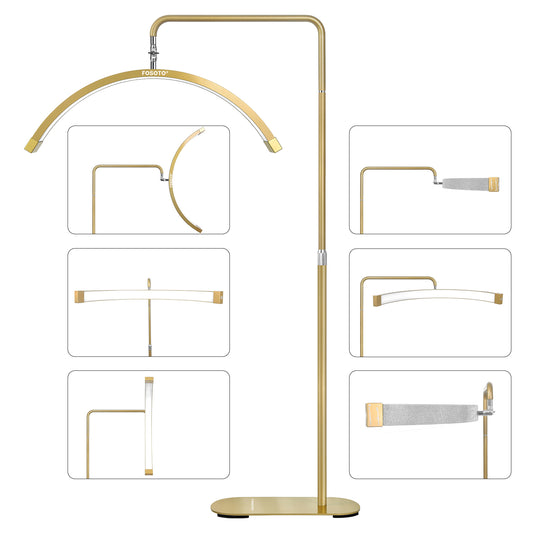
The lamp the studio asked about is the 29-inch ceiling-mounted half-moon. Here is what it is, in the terms above.

It hangs from the ceiling and retracts, which is not a cosmetic detail. Tripods and floor stands occupy the exact floor space where a stool, a trolley and a pair of legs need to be. A retractable ceiling mount also lets you set the height once, per client, and pull the arch down to a repeatable working plane instead of nudging a stand until it looks about right.
At 73 cm (29 in) across, the arch wraps the work area rather than spotting it. Combined with stepless dimming and a 3200–5600K range on the wireless remote, you can hold a warm, low-glare setting for pigment judgement and lift to a cooler, brighter setting for detail and photography without changing lamps.
| FT-Y22 | Specification |
|---|---|
| Format | Ceiling-mounted, retractable half-moon arch |
| Size | 73 cm / 29 in |
| Power | 45 W |
| LED count | 320 pcs SMD |
| Colour rendering | Ra > 95, R9 ≥ 82 across the professional range |
| Colour temperature | 3,200 K – 5,600 K, stepless |
| Dimming | Stepless, wireless remote, memory function |
| Flicker | Flicker-free LED, no heat at the working plane |
| Body | Aluminium alloy and ABS |
| Colours | White / black |
Every light in our professional range is specified at Ra ≥ 95 with R9 ≥ 82. That is the specification we build to, and it is why the numbers in the table further up the page are where they are.

 FT-Y23 ceiling-mounted retractable detail
One thing we will not do
The studio asked for the illuminance at 91 cm and for a report covering that measurement.
We have the spectral report. We do not, in that document, have a lux reading taken at 91 cm below the FT-Y22. So we are not going to print a number and let it look measured.
What we will do instead is tell you how to settle it in twenty minutes, with the lamp in your own room, because your room is not our lab:
- Set the lamp at the height you will actually work at — for most people that is the arch about 90 cm above the client's face, which is the three feet the studio described.
- Set the colour temperature you will actually use for pigment judgement, and full brightness.
- Put a lux meter on the plane of the skin, not on the table and not on the floor. A phone lux app is fine for a sanity check; a €30 handheld meter is better and repeatable.
- Take five readings — centre, and four points about 15 cm out. The centre number is the headline; the spread tells you whether the arch is even or hot in the middle.
- Compare, don't chase a number. 800–1,500 lux at the work plane is comfortable for fine detail work over a long session. Above roughly 2,000 lux at the face you start paying for it in glare and fatigue, and the client starts squinting, which changes the skin you are trying to read.
If you send us your meter reading and your distance, we will tell you whether it looks right for that fixture, and we will not pretend the answer is always yes.
The short version
R9 is the number that decides whether you can trust your eyes on red. Ra hides it, because red was never in the average. Lux at the work plane is the number that decides whether the light is usable at three feet, and it is meaningless without the distance attached to it.
A studio that asks for both, in writing, with a report attached, is not being difficult. They are doing the job properly — and they are the reason we test at all.
If you are setting up a treatment room and want to work through the geometry — ceiling height, arch size, working distance, warm versus cool for pigment — send us your room and we will do the sums with you.
Where to go next
- Ceiling-mounted, retractable, 29 in — the FOSOTO FT-Y18 45W half-moon light is the fixture in this post.
- Wall-mounted instead of ceiling — the FOSOTO FT-Y19 half-moon lamp suits rooms where the ceiling is occupied or the chair moves.
- A multi-angle half moon light — the FOSOTO FT-Y16 multi-directional arch use for all beauty salon.
 FOSOTO FT-Y16 multi-angle half-moon lamp
 FOSOTO FT-Y11B desktop arch light
Questions people actually ask
Is R9 80 good enough for cosmetic tattoo work? As a floor, yes. It is the point where red stops being the limiting factor in your judgement. R9 90+ gives you margin — margin for a dimmed setting, for a warm setting, for the second lamp in the room that is two years older than the first.
Why does R9 drop when I lower the colour temperature? Because the spectrum shifts toward red and the phosphor mix changes with it. In our own report R9 goes from 97.6 near 6000K to 86.6 near 2900K. If you work warm, ask for the R9 at your warm setting, not the headline daylight figure.
Does a higher lux number mean a better lamp? No. Lux without distance is not a measurement, and beyond a point more lux at the face costs you comfort and makes the client squint — which changes the skin tone you are reading. Evenness and colour fidelity matter more than raw brightness.
Can I use a phone lux app to check my lamp? For a sanity check, yes. Phone sensors are uncalibrated and vary by model, so treat the number as relative — useful for comparing two lamps or two heights, not for certifying an absolute figure.
Do you provide the test report with the light? Ask us and we will send the spectral report for the light engine, with the test date, the instrument and the colour temperatures used. We would rather you saw the raw data than a badge.